Top

Soft sensors / virtual sensors that know your process

Soft sensors — also called virtual sensors — combine system knowledge with available measurements to deliver reliable estimates of variables that are expensive, inaccessible, or impossible to measure directly.

Need a soft sensor for your plant or machine? Start with the Soft-Sensor Remote Diagnostic: 5 days, €4,500 fixed, fully remote.

What Are Soft Sensors / Virtual Sensors?

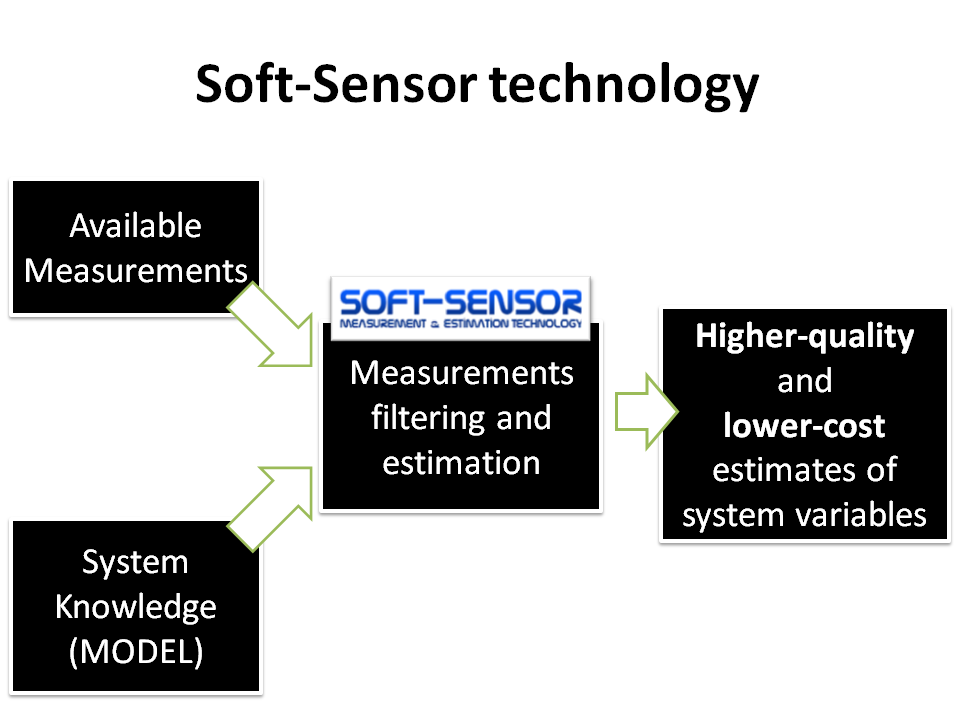
A soft-sensor — also called a virtual sensor — uses a mathematical model of the process together with existing measurement data to compute an estimate of a variable of interest. Unlike a physical instrument, a soft-sensor or virtual sensor requires no additional hardware — it runs as software on existing control systems, exploiting the instrumentation already in place.

Soft-sensor architecture: system knowledge + measurements → estimation algorithm → virtual sensor output
Soft-sensor / virtual sensor architecture — adding system knowledge to available measurements.

Industry Problems Solved

Measurement is too expensive

Problem

Analytical instruments for quality, viscosity or composition cost €50k–€500k and are shared across streams — giving only periodic samples, not continuous data.

Solution

A soft-sensor delivers continuous estimates between analyzer samples, enabling tighter real-time control.

Instrumentation cannot be installed

Problem

Flow meters at valve locations, heat loads in cryogenic circuits, or torque in sealed drives cannot be instrumented due to cost, space, or harsh conditions.

Solution

A soft-sensor computes the variable from correlated upstream/downstream measurements already present in the system.

No direct measurement exists

Problem

Variables such as polymer melt index, cell concentration, or catalyst activity have no real-time in-line sensor technology.

Solution

A soft-sensor infers these variables from measurable proxies — temperature, pressure, flow, spectroscopy — using first-principles or data-driven models.

Sensor failure and redundancy

Problem

Critical measurements fail during startup, upset, or fouling. A single point of failure in a safety-critical loop cannot be tolerated.

Solution

A soft-sensor merges redundant measurements from multiple instruments or correlated variables to provide a fault-tolerant estimate that remains valid when individual sensors fail.

Measurement accuracy

Problem

Two instruments measuring the same variable may have complementary accuracy profiles — one fast but noisy, one slow but precise.

Solution

A soft-sensor fuses both signals using optimal estimation theory to produce an estimate that is simultaneously fast, precise, and drift-free.

Technology

Measurements

The exact sensor requirements are determined case by case. In most cases, existing instrumentation is sufficient — no new hardware is needed.

Models

Models encode the system knowledge exploited by the soft-sensor. Complexity ranges from simple empirical correlations to full thermo-hydraulic or kinetic dynamic models with hundreds of state variables. We specialise in first-principles modelling for process industry and aeronautical applications.

Estimation Algorithms

From linear observers (Luenberger, Kalman Filter) to nonlinear algorithms (Extended Kalman Filter, Unscented Kalman Filter, Moving Horizon Estimation). The choice depends on the degree of nonlinearity, available compute, and required accuracy.

Results from my own work

Industrial Applications & Published Reference Results

Published benchmarks from peer-reviewed literature — what soft-sensor technology achieves in real industrial settings. Third-party results, each linked to its source.

Chemicals / Polymerization

Polymer quality measures are available only from infrequent laboratory analysis, and they depend nonlinearly on reactor temperatures and feed rates.

Nonlinear model predictive control with a first-principles model (material balances with rate expressions, energy balance) controls the laboratory-measured quality in closed loop by setting the reactor temperature profile.

Key finding: In continuous production use since October 2012.
Source: Bindlish (Dow Chemical) — Computers & Chemical Engineering (2015)
Pulp & Paper / Tissue

Basis weight (g/m²) cannot be measured in real time in the wire section of a tissue machine — only downstream, too late to correct deviations.

Hybrid model: a first-principles model and a 1D convolutional network in parallel; a GRU network weights their outputs according to the current operating regime.

Key finding: RMSE 2.12 g/m² (hybrid) vs 2.68 g/m² (machine learning only) vs 4.72 g/m² (physics only), on 7 months of industrial data.
Source: Othen et al. — RWTH Aachen / Nordic Pulp & Paper Research Journal (2025)
Oil & Gas — Downhole Pressure

Permanent downhole gauges are expensive and unreliable in harsh well conditions, yet bottom-hole pressure is critical for production optimization and flow assurance.

An LSTM soft sensor trained on wellhead and topside measurements; transfer learning adapts the model to other wells and operating conditions.

Key finding: MAPE consistently below 2 % on real offshore datasets from the Brazilian pre-salt basin.
Source: Fernandes et al. — arXiv (2026)
Power Generation — NOx Emissions

Real-time NOx prediction is the basis for combustion optimization; working conditions shift with load and fuel, so static models degrade.

Just-in-time learning with a random forest: a local model per prediction, selected by a temporal-spatial similarity index, with moving-window monitoring that triggers updates.

Key finding: R² = 0.93 on the test set; 99.7 % of samples within 15 mg/m³ absolute error — better than all six comparison models.
Source: He & Ding — Sensors / MDPI (2024)
Wastewater Treatment

COD, TSS and E. coli need sampling and laboratory analysis, so there is no real-time view of treatment performance; online COD analysers are too expensive for onsite systems.

Machine-learning soft sensors on in-line measurements (turbidity, color, pH, NH₄⁺, NO₃⁻, conductivity). Four algorithms compared; SVR was best for COD, cubist regression for TSS.

Key finding: COD: R² = 0.96 (SVR); TSS: R² = 0.99 (cubist) — on 56 data points from a field-tested onsite treatment system; E. coli could not yet be predicted reliably.
Source: Shyu et al. (Univ. South Florida) — ACS Environmental Au (2023)
Pharmaceutical / Process Analytical Technology (PAT)

Critical quality attributes of tablets — content uniformity, dissolution, hardness — are traditionally measured off-line at the end of the batch, which blocks real-time release testing (RTRT).

Soft sensors infer the quality attributes from in-line PAT instruments (NIR, Raman, laser diffraction) and process data during manufacturing, within the FDA PAT framework.

Key finding: Review of the state of the art of real-time release testing of tablets; the FDA PAT guidance has been in place since 2004.
Source: Markl et al. — International Journal of Pharmaceutics (2020)
Semiconductor / Virtual Metrology

Metrology steps (film thickness, etch depth, CMP endpoint) are expensive and sampled rarely, leaving quality blind spots between measurements.

Virtual metrology predicts post-process quality from equipment status and process variables, using sampled real metrology to train and correct the models.

Key finding: Review of two decades of virtual-metrology literature: generic steps for a successful VM, the state of the art, and open problems.
Source: Maitra et al. — Expert Systems with Applications (2024)
Automotive / Autonomous Vehicles

Higher automation levels need more sensors per vehicle — from 8 to 28 in the paper’s overview — adding cost, weight, power and failure points.

Virtual sensors replace or supplement physical units and are validated in full-vehicle simulation; state estimation uses Kalman-family observers and hybrid machine-learning approaches.

Key finding: Virtual-sensor market: USD 1.37 bn (2025) → USD 5.35 bn (2030), as cited from Mordor Intelligence.
Source: Barabás et al. — Sensors / MDPI (2025)

Soft Sensor / Virtual Sensor vs Physical Instrument

A direct comparison for procurement and feasibility decisions.

AspectPhysical InstrumentSoft Sensor / Virtual Sensor
Upfront cost €50k–€500k per instrument Software only — runs on existing DCS/PLC
Installation Weeks to months (civil works, cabling) Days to weeks (model integration)
Maintenance Calibration shutdowns, fouling, replacement Model update — no process downtime
Coverage One physical location per device Any variable reachable by the model
Data rate Periodic (analyzer: 1–2 h) or single point Continuous, synchronous with control cycle
Failure mode Hard failure — loop goes open Graceful degradation — model-only fallback

Developments

Advanced Virtual Flow Meter

Software-based flow calculation at valve locations using valve position, pressure and temperature measurements — no physical flow meter required.

About the virtual flow meter

Digital Variometer SSDV12

High-precision climb/descent rate sensor for paraglider pilots using soft-sensor data fusion of pressure, inertial and GPS measurements.

About the SSDV12 variometer

Sensor fusion & state estimation — references

My own work on estimating what cannot be measured directly: peer-reviewed publications and industrial projects.

Publications

Projects

  • CERN, LHC cryogenics — nonlinear moving-horizon estimation of the superfluid-helium circuit state from sparse pressure and temperature measurements, run in real time for output-feedback NMPC and tested at CERN.
  • IAV — nonlinear state estimation for utility-scale wind turbines, as part of model-based and economic NMPC development.
  • SkySails Power — state estimation for automated flight of airborne-wind-energy kites.
  • Digital variometer SSDV12 — climb-rate estimation fusing pressure, inertial and GPS measurements.
  • Advanced Virtual Flow Meter — flow at valve locations estimated from valve position, pressure and temperature, without a physical flow meter.
  • Freelance — state estimation and sensor fusion for paraglider flight control.

Full publication list on noga.es →

Frequently Asked Questions

What is a soft-sensor / virtual sensor?

A soft-sensor is a software model that computes estimates of hard-to-measure process variables from existing instrumentation. No new hardware is required — it runs on your existing DCS or PLC.

Do I need to install new sensors?

In most cases, no. The soft-sensor uses measurements already available in your control system. The exact requirements are assessed case by case.

How accurate are soft-sensors?

For well-instrumented processes with a good first-principles model, estimation errors of 1–5% are typical. The CERN LHC cryogenics application estimated 5 thermodynamic states from 3 pressure sensors.

How long does a project take?

Typically 4–12 weeks from kickoff to commissioning, depending on model complexity and data availability. A 30-minute feasibility call is enough to scope the work.

What happens when the process drifts or changes over time?

Process drift — from wear, feedstock variation, or production grade changes — is the most common cause of soft-sensor degradation. Robust deployments include model health monitoring (rolling RMSE, drift indicators), retraining triggers, and rollback to the previous model version. For processes with frequent regime changes, Just-In-Time (JIT) or adaptive models that recalibrate locally are preferred over static models.

Can a soft-sensor replace a physical sensor in a safety instrumented system?

Soft-sensors are highly valuable as advisory, monitoring, and redundant estimation channels. Using them as the sole measurement in a safety-critical loop (SIF) requires demonstrating deterministic failure modes, independence from other measurements, and full safety lifecycle compliance per IEC 61511. In practice, soft-sensors are deployed as a complement to physical safety instrumentation, not as a replacement for it.

Stay informed

Occasional updates on soft-sensor methods, case studies, and new products. No spam.

Practical Entry Point

Soft-Sensor Remote Diagnostic

€4,500 fixed · 5 days · fully remote

You built the next generation of your machine — bigger for efficiency, simpler for cost. You ported the existing controls. The soft sensor does not track the new dynamics.

A focused 5-day remote engagement to assess your process-control problem. I work from your historian data and short interviews with your team to deliver a clear, actionable diagnostic — no plant visit, no long sales cycle, no commitment to a bigger contract.

  • Process review and bottleneck identification from data
  • Control-loop health assessment (oscillation, saturation, sluggishness, valve wear)
  • Quick-win opportunities with realistic ROI estimates
  • Recommended technical approach (APC/MPC, soft sensors, optimization)
  • Go/no-go assessment for a PoC and a rough effort + cost estimate

You get: 1-page executive summary + technical report + 60-min Q&A call.

You provide: ≥ 1 week of historian data, P&ID or schematic, 1–2 short interviews with your operators/engineers, NDA signed before any data exchange.

Book a 30-min technical fit call The 30-min technical fit call comes first — to confirm fit before invoicing.

About

Soft-Sensor is a specialised engineering practice led by Dr. Rafał Noga — APC/MPC consultant with experience in soft-sensor and state estimation for process industry, cryogenics, and aeronautics since 2007.

→ APC & industrial AI consulting: noga.es